Press · Data release and comment · November 2026
Household hot water savings 'could be bigger than solar'
Australians have an opportunity to save money on their power that is equal to the potential of solar, but most of them may not even be aware of it, the founder of a national heat pump marketplace says.
PumpSwap founder Josh James said controlling when a home heats its water had the potential to benefit households significantly, if it was used well.
He said Australia had had off-peak hot water for decades, with network-controlled “controlled load” tariffs that let the poles-and-wires companies switch cylinders on overnight to keep the grid steady.
Smart meters, time-of-use plans and, from July this year, the federal Solar Sharer Offer were now putting that benefit in the hands of households instead.
“There are a lot of plans that reward you for letting your hot water run at the right time,” James said. “If your hot water sits on a controlled load tariff you already get a cheaper rate. A smart meter and a time-of-use plan give you more, because you choose the window.
“It’s significant, because if you look at hot water, it’s about a quarter of a household’s energy use. It’s the second biggest thing in the house after heating and cooling.
“It’s a really big area for people to save money.”
He said the technology allowed consumers on time-of-use plans to heat their water overnight when power was cheap, or in the middle of the day when the grid was flooded with solar.
“Your hot water only comes on during the low-cost periods. If that’s a quarter of your energy use and you’re doing it at a fraction of the rate, that saves you heaps of money.”
People could put a timer on an existing electric cylinder, he said, while a heat pump hot water unit did the same job with about a quarter of the electricity, and most new units had the timer built in.
James said his own advice was simple: heat it when the power is cheap and the tank will stay hot.
“There is no downside to heating up at night, or in the Solar Sharer window.
“If people are looking to save money, buying a hot water heat pump and running it on low-cost electricity, you can really make a big dent in your household electricity costs.
“I always say, for a lot of people, for a lot of large households, it’s probably more than solar.
“It’s a more surefire way of saving money, I believe, for many households, large households with kids who are using a lot of hot water. A heat pump is $2,400 to $4,700 installed after rebates, about the money a small solar system costs. For the half of homes still heating water with gas, the panels never touch that bill. The heat pump does, and it could make a bigger impact than putting solar on.”
He said having solar as well would be ideal, because the water could be used as a type of battery for the solar system.
“You can set the heat pump to run on your excess solar in the middle of the day, rather than sending it back to the grid for a few cents.”
Under the federal Solar Sharer Offer, live from 1 July 2026 in New South Wales, South Australia and South East Queensland, eligible households get three free hours of electricity in the middle of the day, 11am to 2pm in New South Wales and South East Queensland and 12pm to 3pm in South Australia, up to 24 kWh a day. It is opt-in through the retailer, needs a smart meter, is open to renters as well as owners, and does not require rooftop solar.
Water heating is the second largest segment of household energy use in Australia, at 15 to 30 per cent depending on the home, according to the federal energy department, and about 25 per cent on average according to the Your Home guide.
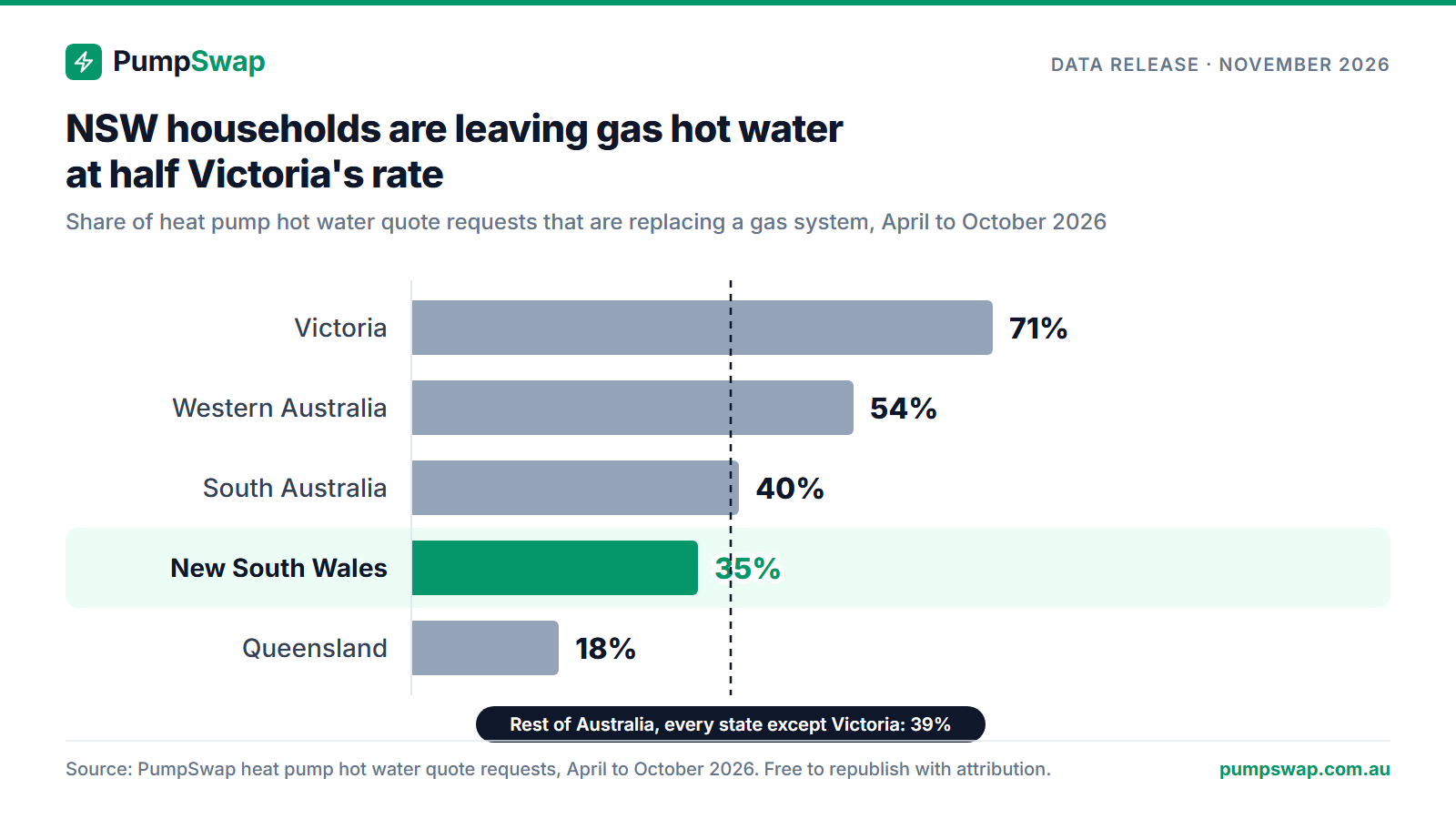
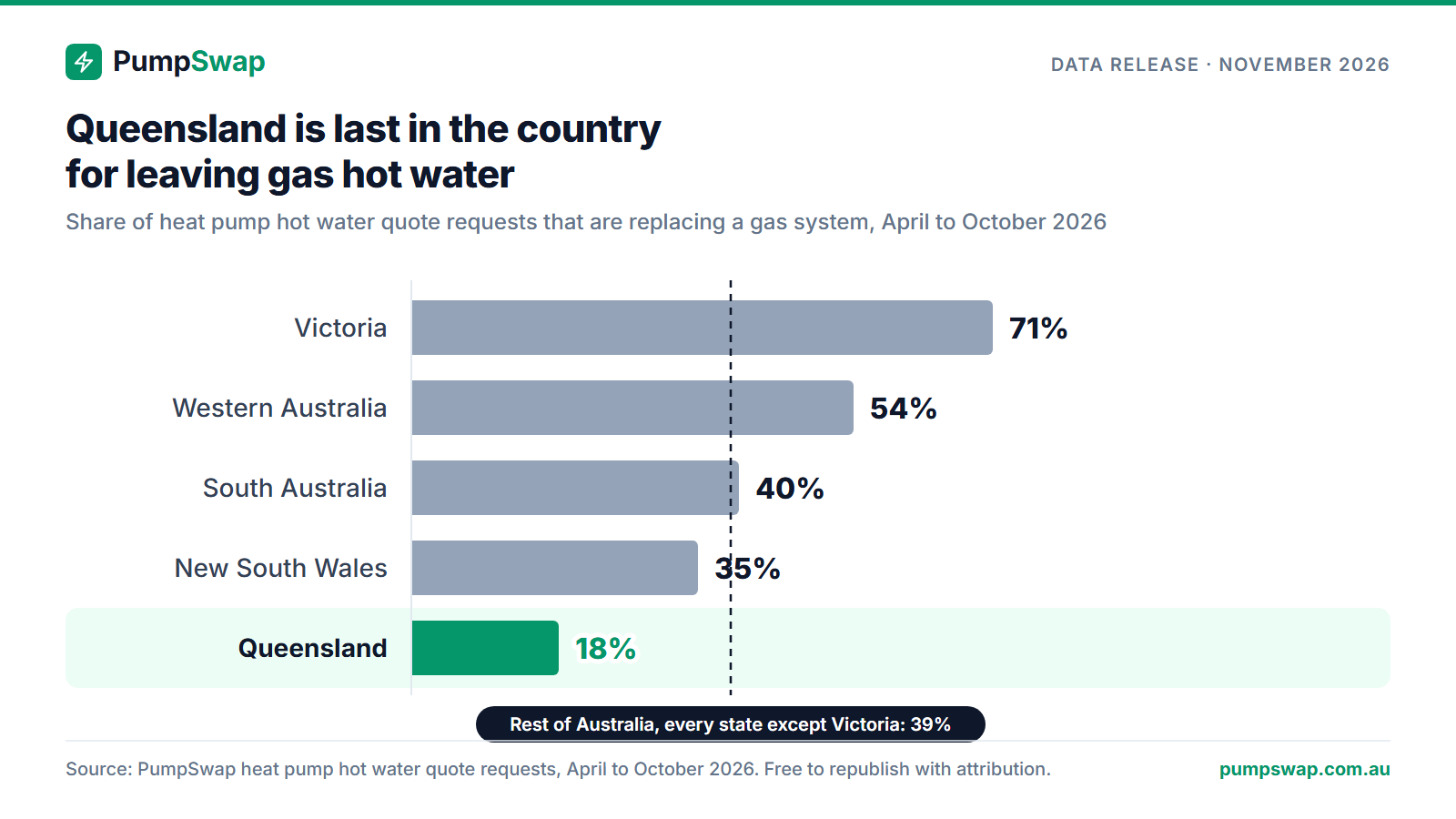
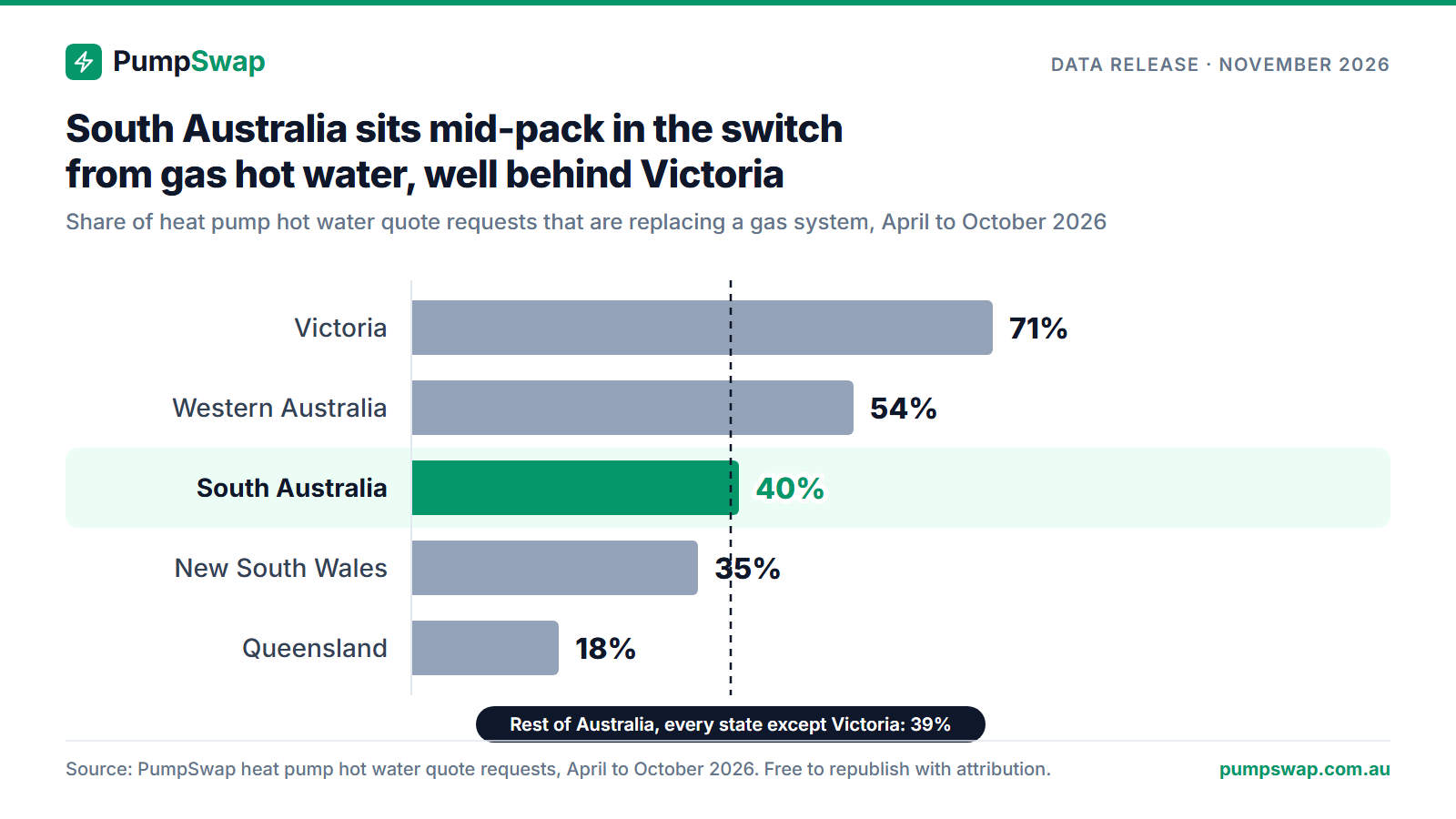
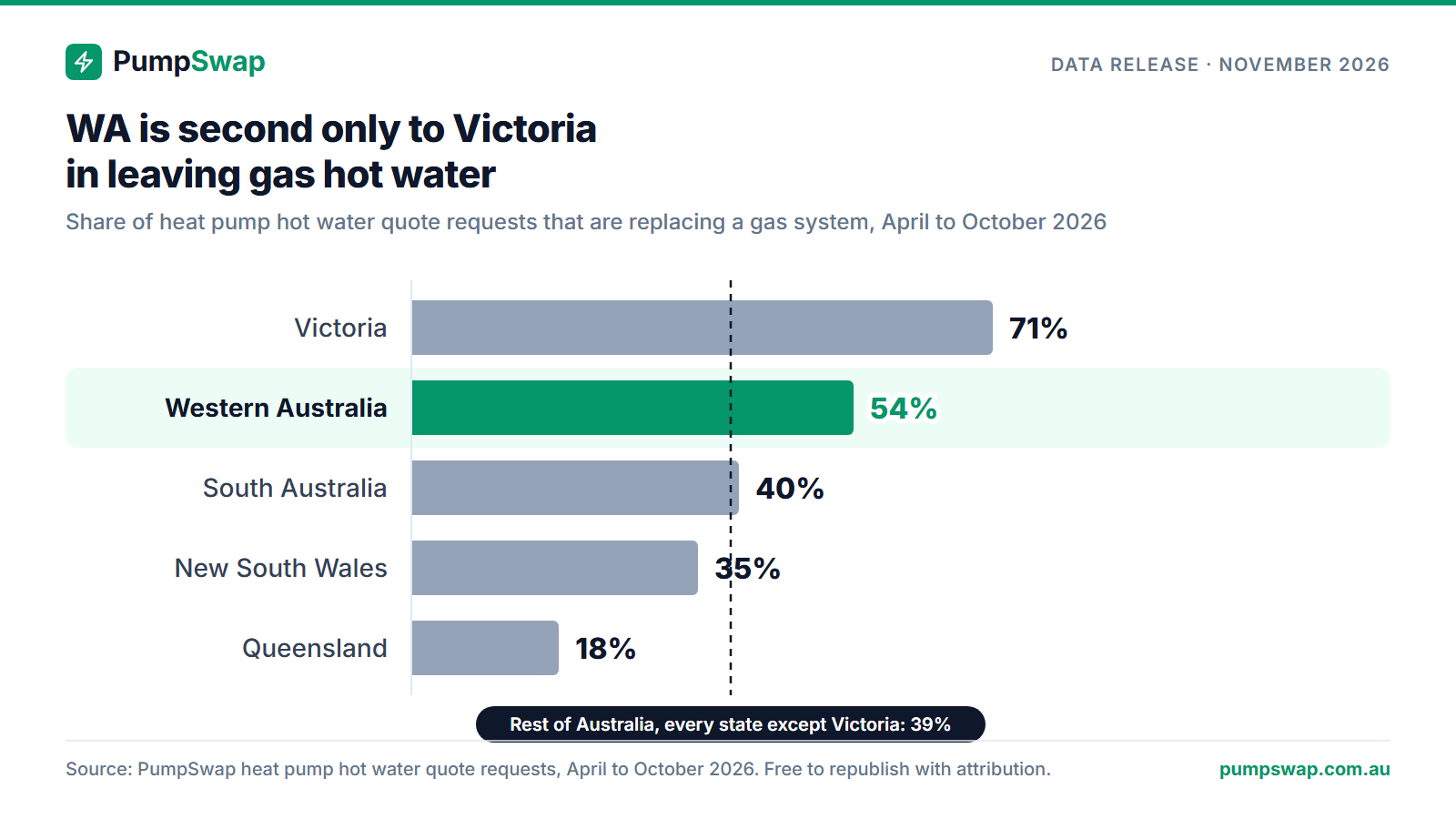
PumpSwap’s own figures, from heat pump hot water quote requests across every state between April and October 2026, show the switch is already under way. Half of all requests came from homes replacing gas. In Victoria it was 7 out of 10, nearly double the rest of the country, with Western Australia at 54 per cent, South Australia 40, New South Wales 35 and Queensland 18.
Most of those Victorian gas switchers moved before the old unit failed: 7 out of 10 replaced a working system.
“People are doing the sums rather than waiting for the cold shower,” James said. “Everyone has been told the answer is on the roof. For half the country the bigger return per dollar is the box in the laundry, because the panels don’t touch a gas bill. In a cost of living squeeze, that’s the order to do it in.”
He said the cylinder was already in every home, owned or rented, which was the point.
“The key element, the hot water unit, is already there. It just has to be the right one, running at the right time.”
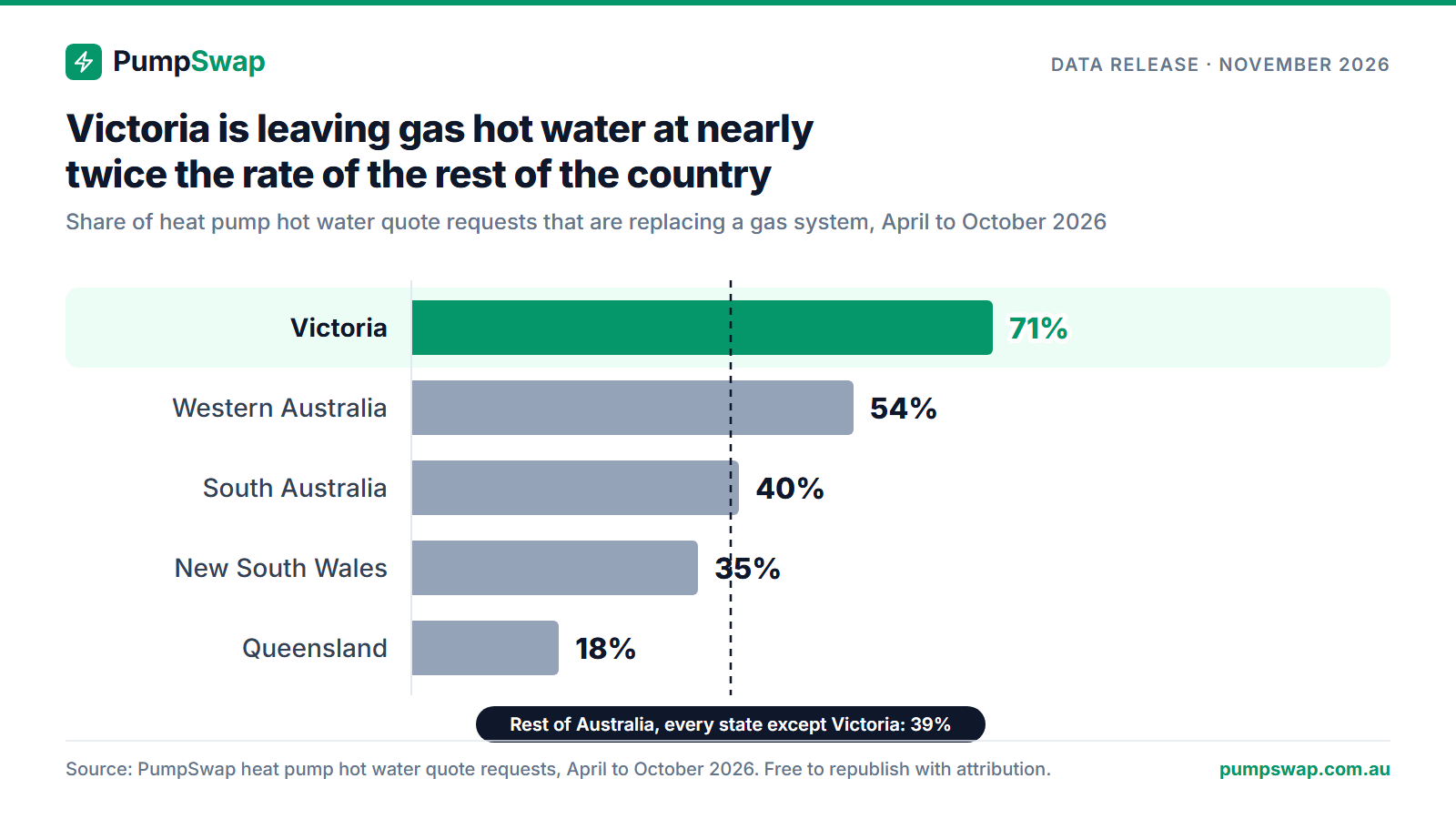
Share of heat pump hot water quote requests replacing gas
April to October 2026, by state:
| State | Replacing gas |
|---|---|
| Victoria | 71% |
| Western Australia | 54% |
| South Australia | 40% |
| New South Wales | 35% |
| Queensland | 18% |
| Rest of Australia (every state except Victoria) | 39% |
Republish the chart
The chart and the table are free to republish with attribution to PumpSwap. Paste this where the chart should appear:
<a href="https://pumpswap.com.au/press/hot-water-vs-solar-2026"><img src="https://pumpswap.com.au/press/gas-exodus-2026/chart.png" alt="Share of heat pump hot water quote requests replacing gas, by state, April to October 2026. Source: PumpSwap" width="800" height="450" style="max-width:100%;height:auto" /></a>
<p>Source: <a href="https://pumpswap.com.au/press/hot-water-vs-solar-2026">PumpSwap</a></p>
Per-state versions with that state highlighted: New South Wales, Queensland, South Australia, Western Australia.
Notes for editors
- Hot water’s share of household energy use: about 25 per cent on average, per the federal Your Home guide (EnergyConsult, 2022); 15 to 30 per cent and the second largest segment, per energy.gov.au.
- Solar Sharer Offer: the federal free-power window, live from 1 July 2026 in New South Wales, South Australia and South East Queensland. How a heat pump fits inside it, with a calculator: Solar Sharer hot water savings.
- Installed prices are modelled, after rebates, from PumpSwap’s live indexes: heat pump hot water and 6.6kW solar, by state and suburb.
- Rebates: the federal discount on heat pump water heaters steps down on 1 January 2027, and state schemes stack on top. Victorian households can take up to $2,830 off a heat pump install. Current figures, each with its official source: heat pump rebates by state.
- The gas exodus figures above are the same dataset as our November release on Victoria, which carries the full state breakdown and the chart files.
About the data
For every quote request, PumpSwap records the system being replaced and whether it is still working, as answered by the homeowner. Figures cover heat pump hot water quote requests received through PumpSwap.com.au between April and October 2026. Test entries are excluded. Percentages are rounded. State figures cover states with enough requests for a meaningful share.
About PumpSwap
PumpSwap.com.au is an independent Australian comparison site for heat pump hot water, solar, batteries and EV chargers. Homeowners request free quotes from local, ABN-verified installers. Installers pay PumpSwap only when they complete an install; homeowners never pay.
Media contact: Josh James, Founder, josh@pumpswap.com.au, email only; written questions answered same day. Please credit “PumpSwap” and link to this page when using these figures or quotes.